
Hardware-In-The-Loop Testing & Simulation Services
At Bermondsey Electronics,, we specialise in hardware-in-the-loop simulation to replicate your product environment and inject test signals. Hardware-in-the-loop (HIL) testing is a powerful tool that allows us to carry out repeatable and portable tests to lower the cost of testing during the design cycle. Get in touch today for more information about our hardware-in-the-loop testing services.
HIL testing is a concurrent simulation that allows hardware engineers to test their embedded coding and controllers without the need for the complete system hardware.
For automotive HIL testing to be of value, the standard of the simulation software is greatly important.
Software used for the simulation should be paired with an excellent standard of hardware that not only makes use of system specifications but also allows for fault. This hardware-in-the-loop testing feature allows an engineer to test realistic scenarios and use cases, which includes errors.
A controller is connected to a test system that imitates the way that a fully assembled product would work in real conditions. Using hardware-in-the-loop simulation, control signals are sent to the product to create a realistic environment, and the system is examined to see how it responds.
Using hardware-in-the-loop simulation and automation, control signals are sent to the product to create a realistic environment, and the system is examined to see how it responds. This is largely useful to diagnose difficult-to-reproduce events, or to test unusual time conditions like leap years. By incorporating HIL test automation, test coverage can be increased efficiently and at relatively low cost.
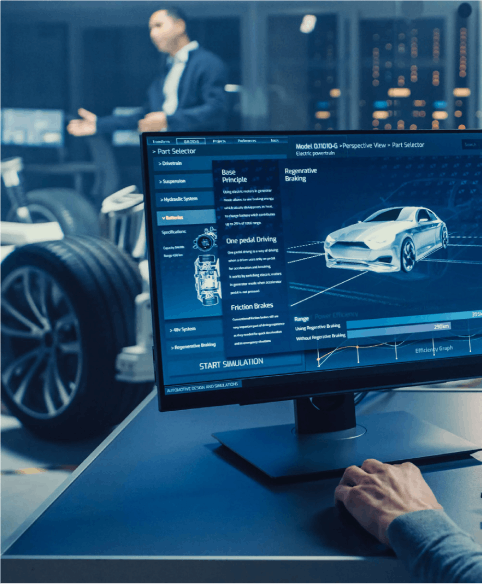

If you want to fast track the launch of your next product without compromising quality or reliability, schedule a confidential discussion with us today about our automotive HIL testing services.
Automotive HIL testing can help engineers to verify designs and test for any abnormal conditions, bugs or faults within the software. It allows for testing in real-time so that realistic behaviours can be recorded. Hardware-in-the-loop testing will help you to reduce time and costs and enhance your test safety.

Our team of experts recognises the importance of automotive HIL testing in product development. With computer interfaces built into modern instruments, this step might not require dedicated hardware. Scripting the tests allows for repeatability, portability, and traceability. It can also be helpful when there is limited access to hardware, such as during the early stages of design. Learn more about our hardware-in-the-loop testing processes below.
Our automotive HIL testing process ensures that every system we evaluate performs reliably under real-world conditions.
From initial requirements gathering to the delivery of comprehensive test outputs, our structured approach provides accurate, repeatable results that support faster development cycles and improved system performance.
Hardware-in-the-loop simulation testing can be used for a variety of applications, including:

We have a strong partnering philosophy and are proud to be supporting companies with firmware programming, including:

Hardware-in-the-loop testing started in high reliability industries and has been advancing lower down the value chain over time. Today, some automotive HIL testing is standard on even low-cost products. At Bermondsey Electronics, our goal is to provide our clients with the highest quality hardware-in-the-loop automotive testing. Our specialist team utilises the latest technologies and methodologies to ensure that their products perform reliably and efficiently.
Hardware-in-the-loop testing is particularly useful in industries using safety-critical systems, such as the automotive industry. However, for those customers looking to increase test coverage, or are looking to test complicated products, it can significantly lower the cost of testing. A configured hardware-in-loop (HIL) test automation suite can be set to run on demand, using hil test simulation to ensure features work at every stage of development and maintenance.
At Bermondsey Electronics, we are committed to delivering exceptional design hardware-in-the-loop testing services that meet and exceed our client’s expectations. Contact us to learn more about our services and how we can help you achieve your HIL testing goals.
Don’t take our word for it, these are kind words from our customers
Bermondsey Electronics Limited is a highly experienced embedded Linux design house. Active in sectors that include aerospace, automotive, security, health and fitness, the company’s design and verification services shorten and de-risk product launches. Contact us today to learn more about our embedded services and how we can help you go to market with confidence.

If you have any questions about how we can help your business, please complete the form below, and we will be in touch shortly.
Alternatively, please call us on +44 (0)208 137 9239
Email : [email protected]
HIL testing is a simulation technique that tests embedded systems by connecting real hardware to a virtual environment. It allows engineers to validate control algorithms and software performance without a fully assembled product, reducing cost and development time.
HIL test automation enables continuous and unattended testing. Automated test suites improve consistency, speed up regression testing, and make it easier to detect software faults early in the design cycle. This helps to ensure higher reliability throughout development.
Software-in-the-Loop (SIL) testing runs entirely in a simulated environment to verify control algorithms before hardware exists. Conversely, hardware-in-the-loop (HIL) testing connects real hardware to a simulation to validate how the software interacts with physical components.
Automotive HIL testing helps detect design and integration issues early, reducing development time and cost. It improves reliability and safety by allowing engineers to test complex systems, such as in electric and autonomous vehicles, under realistic, controlled conditions.